


New Books Section
Visit the modern Books page

GFA Books Features:
GalaxyFarAway.com Interview with Michael P. Kube-McDowell
DevanJedi
(DJ) of GalaxyFarAway.com talked to Michael Kube-McDowell (MKM) on the 26th of
March, 2000.
Page 1 | Page 2
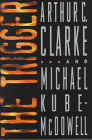
DJ: Let's leave the Star Wars galaxy for a second. Your newest novel is called "The Trigger", and you wrote it in collaboration with the scifi literary legend Arthur C. Clarke. How did this collaboration come about?
MKM: Well, to be honest, it still kind of seems to me like having one of the gods reach down from Olympus and select a mortal to join him on a quest. <g>
I was working on TYRANT'S TEST when my agent called and asked, "Would you like to write a book with Arthur C. Clarke?" I can't tell you why me--I can only tell you that when I finally read Sir Arthur's outline for THE TRIGGER, it read like something I might have written myself. I felt an immediate affinity for the material. And I can tell you that Sir Arthur has been wonderful throughout--a gentleman in every way, who never once made me feel like anything other than a peer and a full partner. The fan in me, the fellow who got Clarke's autograph on a copy of CHILDHOOD'S END in 1973, though, still can't quite believe it. |
 Buy |
DJ: I can understand (I'm a HUGE fan of his
myself!) How did you stay in touch?
MKM: Because of the time difference between Michigan and Sri Lanka, it was mostly done through e-mail, though we've also talked on the phone any number of times. Much of the research was done on the Net as well, and 99% of our contact with both the American and British publishers was over the Net. The very model of a modern novel. <g>
DJ: There have been a lot of such collaborations lately in the Sci Fi world. What do you think has brought about this trend? Also, as an author, how is it different from writing the book on your own?
MKM:
These so-called junior-senior collaborations happen for a variety of reasons. Some are, frankly, just a way for the senior writer to "franchise" a fictional universe or a bankable name. Some are sincere efforts by the senior writer to "pay forward" by helping young writers establish themselves. In the case of both THE TRIGGER and Clarke's collaboration with Stephen Baxter, the reasons mostly have to do with Sir Arthur's health--he has a serious case of post-polio syndrome.
Both of these projects were important enough to him that he wanted to see them written even if he couldn't write every word.
He was involved with both novels from beginning to end, and I consider them both true collaborations which arose out of the "right" reasons.
By comparison, when I wrote "Isaac Asimov's Robot City" in 1985--the first of the so-called "sharecrop" or borrowed-universe novels... --I never spoke with Asimov, never corresponded with him. It was strictly a hired-pen situation, a work for hire. I don't think Asimov even wrote the outline for the ROBOT CITY series. I think you can often get a clue as to the kind of "collaboration" you're holding by looking at the copyright.
DJ: The Trigger takes a stand on many social/political issues (which is a little new for the Sci Fi genre) such as disarmament and gun-control. How much of this is your own views?
MKM: I don't think THE TRIGGER is a didactic novel--one that tells you what should be done, what you should believe. It's a speculation on what might happen if we found ourselves with a weapon against firearms. The prime movers in the story are meliorists--they think that the world can be made better through human effort, and they find themselves with a tool that they can use in that effort. But the characters are speaking for themselves, not for the authors. I think the last couple of pages of the book underline that. Nevertheless, I think it's fair to say that Sir Arthur and I both see the gun culture in which so much of the world is immersed as tragically destructive.
Sir Arthur has been witness to two decades of terrorism and guerilla warfare by the Tamil Tigers against the government of Sri Lanka, and here in America I've had to watch what seems like an ever-increasing parade of empathy-dead children, disgruntled employees, and disaffected "patriots" make their way to the headlines and the evening news. I think if you're paying attention at all, it has to have an effect on how you react to the idea of unrestricted 'gun rights'.
And maybe that's a good way to think about THE TRIGGER, too. It doesn't take a stand on guns and violence, but it does take a hard look at them, and at how the issue divides us, and at the price we pay for the choices we've made. THE TRIGGER is about the idea that if we had other choices, those who live in hope of something better would try to lead us there. Or drag us there.
In a way, it's Sir Arthur's and my answer to the question, "Can you imagine a world without guns?" How you envision that world says a lot about how you see human nature and human
society-- whether peaceful cooperation or bloody competition dominates your worldview.
Those who take the latter view would envision something closer to post-Holocaust anarchy. Our view is rather more hopeful, though hardly utopian or idealistic. "We can do better" is an idea that both Sir Arthur and I can embrace.
DJ: And finally, any advice for would be SciFi/Fantasy writers?
MKM: I grew up reading science fiction that was hopeful about the future, that implicitly accepted the idea that we can do better. I still prefer that flavor in the storytelling mix.
Advice for new writers? <sigh> It's a very tough business right now. Much more so than when I broke in. Especially for science fiction writers (as opposed to fantasy writers). I think the old maxim applies double now--don't quit your day job. There is still room for new voices, but it's harder than ever to make a living unless you have break-out bestseller success early.
So write what you love, if you're writing for love. And if some measure of commercial success comes out of that, count your blessings. I've worked like a dog, and I've also been very lucky. And I count my blessings every day I'm able to continue doing this for a living.
DJ: Thank you so much for taking the time to talk with GalaxyFarAway.com and we wish you all the best for your work in the future.
MKM: You're welcome.